From Hype to Concern: How Is AI Really Impacting the Insights Industry?

Artificial Intelligence (AI) has become one of the most debated forces in the market research industry, rapidly expanding in its relevance while raising new questions about quality, trust, and its impact on professionals’ roles.
In the 2025 Market Research Industry Pulse Report, IntelliSurvey breaks down both the hype and concern around AI and brings to light key insights into how market research professionals think about this ever-changing technology.
Bottom line up front: AI brings speed and scale, but also concerns, as its potential to elevate the craft is tempered by fears it could increase response fraud, erode human judgment, and minimize expertise.
Optimism Exists (In Certain Areas)
In our survey, many market research professionals reported that AI is enhancing their work, calling out speed, quality, and efficiency as highly valuable outcomes.
We asked:
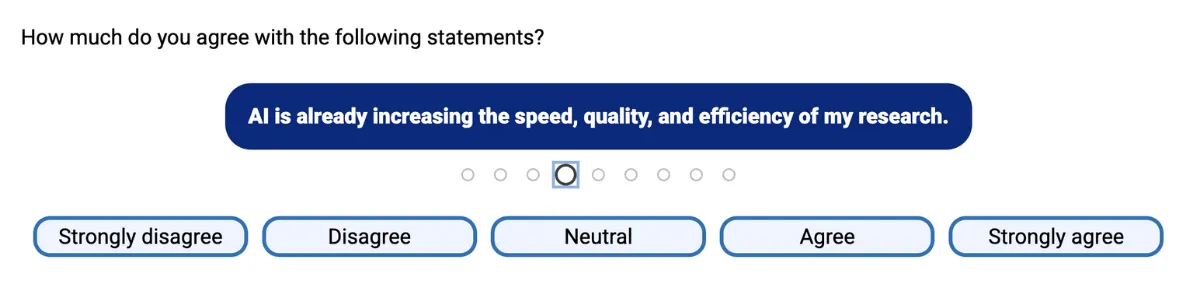
Over half of respondents (54%) agreed that AI has already increased the speed, quality, and efficiency of their research.
Interestingly, this positive sentiment was expressed most strongly among medium-sized organizations (62%), whereas large and small organizations showed similar but lower levels of agreement (57% and 50%, respectively). We also noted a difference in responses between non-North American participants (66% agreement) and their North American counterparts (50%).
AI Translations
In the pre-AI era, machine translations for international market studies were often unreliable and thus seldom used, even as first drafts. The introduction of new AI tools has improved the reliability of English translation.
To understand how respondents’ perceptions align with these findings, we asked professionals:
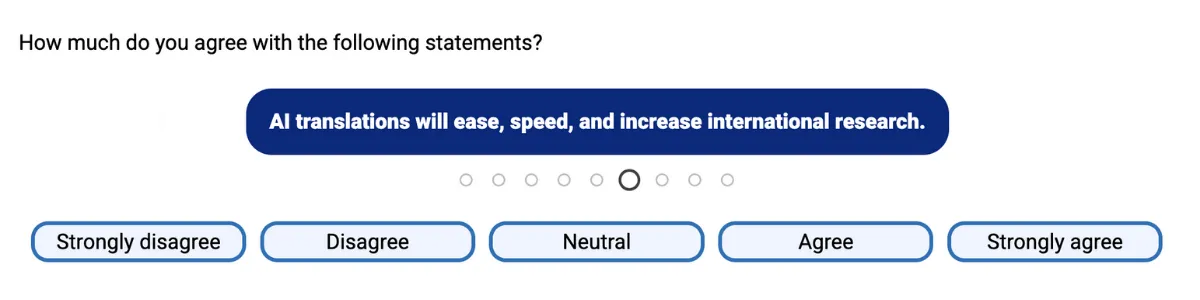
76% of respondents expressed agreement. We observed this positive sentiment across all organizations, ranging from 66% in small organizations to higher rates in medium (74%) and large (95%) organizations.
Purpose-Built Tools Are Leading the Way
The introduction of purpose-built research tools like AI drafting, open-ended coding* (OE), OE response probing, translations, and autosampling has increased the efficiency of day-to-day workflows for many research professionals. As a result, we predict that market research teams are likely to increase their adoption of AI tools to match rising client expectations for speed and efficiency.
Based on the optimistic responses outlined above, new conversations will no longer be a question of whether or not to use AI, but rather how to operationalize it across communications, research drafting, writing, and final data presentation.
*Within the 2025 Market Research Industry Pulse Report, IntelliSurvey also explores how tools like AI open-ended coding can assist with the speed of qualitative research analysis and highlights which methods produce results closest to human coding.
The Drawbacks: Concerns About AI
Despite the positive opinions expressed thus far, many respondents remain highly concerned about AI.
AI Replacing Humans
When asked the open-ended question, “Thinking of your research activities, what keeps you up at night?”, the fear of AI replacing humans ranked second, only behind concerns about data quality. This anxiety about AI places it on par with longstanding pressures, including the future of the market research industry, budget constraints, and methodological innovation and experimentation.
The fear of replacement is not isolated to the market research industry. In 2025, the Pew Research Center found that nearly one-third of workers across industries believe that AI will reduce their job prospects.
Our report showed similar concerns amongst market research professionals, with 41% of respondents fearing that AI will lead to a loss of relevance and expertise. Many believe AI is being pushed too fast without a clear understanding of its limits (52%), reaffirming AI as a frequent issue that keeps professionals up at night.
AI’s Impact on Data Quality
When respondents were asked, “Which of the following are your biggest data quality concerns?” The two most common responses were:
- “AI-generated responses” (74%), making it the most commonly cited concern.
- “Bot responses” (72%), which often include elements of AI.
AI’s ability to disrupt data quality in surveys and passive collection methods means that the industry will need to adapt to this new AI-saturated landscape or risk irrelevance. In the short term, this requires industry professionals to take respondent screening much more seriously to combat AI-generated responses in their samples; in the long term, the industry will need to adopt new data collection standards and methods that make it very difficult for AI-generated responses to enter datasets in the first place.
Are We Already Behind the Curve?
Sentiments were mixed regarding whether professionals in the market research industry believe the industry is falling behind on AI. The survey explicitly asked:
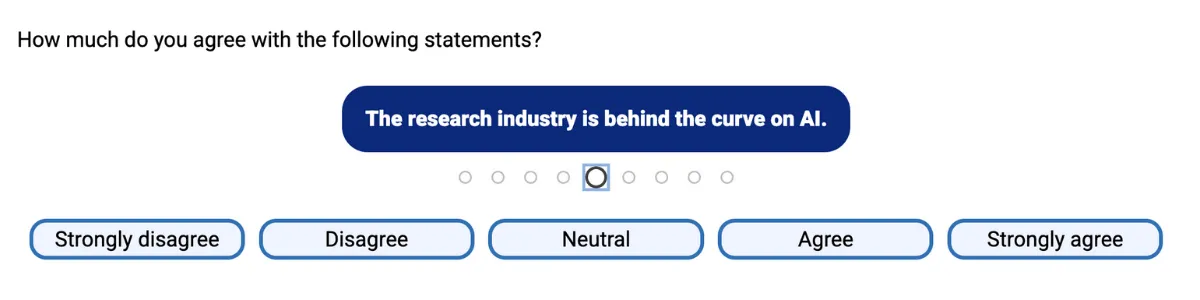
Opinions were split almost evenly: 32% agreed, 32% disagreed, and 36% were neutral. Respondents outside North America were most likely to agree that the industry is behind the curve (41%), with 69% of participants from Asia agreeing, and 23% of Europeans compared with 27% of those in the U.S. and Canada.
This lack of consensus suggests that perceptions of AI readiness are not shaped by an industry-shared standard but are informed more by individual context, exposure, and experience.
In Summary
From accelerating research and improving translations to being the thing that keeps professionals up at night, we can see that AI is already reshaping the market research industry.
For a deeper look and a full breakdown of the survey’s findings, download the 2025 Market Research Industry Pulse Report.