Research Results: The Financial Mood Gap
Foreword
Over the course of multiple articles, IntelliSurvey has been examining and analyzing a sentiment-based dataset. In this article, we will focus on an income-based analysis of the financial sentiment data. If you would like to learn more about the dataset, the survey that created it, or read other articles from the IntelliSurvey team, please visit the IntelliSurvey blog.
Introduction
Across the U.S. and U.K., people’s overall mood is more positive than negative, with 43% reporting positive sentiment scores and 10% reporting negative. But that optimism fades when the topic turns to finances. When respondents were asked how they felt about their current financial situation, positive sentiment fell to 23%, while negative sentiment rose to 23%. Where overall sentiment skewed positively, financial sentiment is balanced between positive and negative, indicating more polarization on the topic. To understand what might be influencing this difference, we need to closely examine how financial feelings and income are connected.
Analysis Sentiment Scores
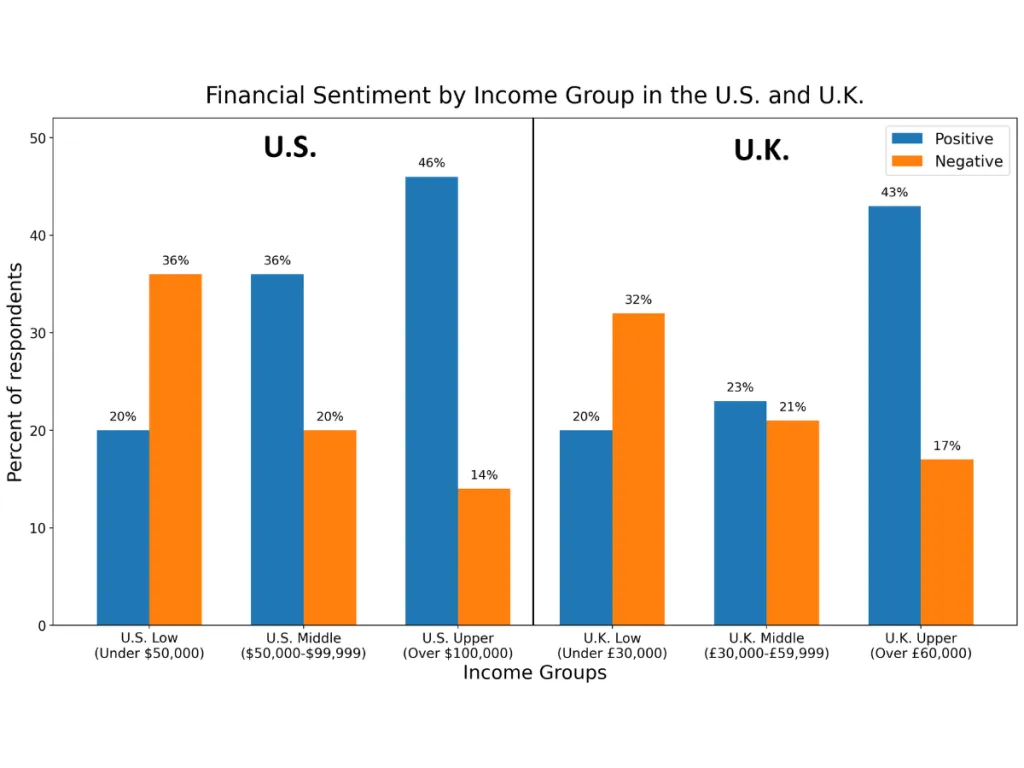
While it seems obvious that financial sentiment and income would be statistically related, a Chi-squared test confirms that income is a strong predictor of financial sentiment. The lowest earners are much more likely to report negative scores than either the middle or upper earners, and upper earners are much more likely to report positive scores than either the low or middle earners. Lastly, to understand the relationship, we look at the Net sentiment for each group to assess the magnitude of each group’s contribution to the sample’s elevated negative financial sentiment. In the U.S., the lowest earners have a net sentiment of -16, and the upper earners have a +32, while in the U.K., the lowest earners have a -12 and the upper earners have a +26. Using the analysis from this section, we can see that the U.S.’s lowest earners have the most negative net financial sentiment, and that there is a financial mood gap between income groups.
Analysis Selected Emotions
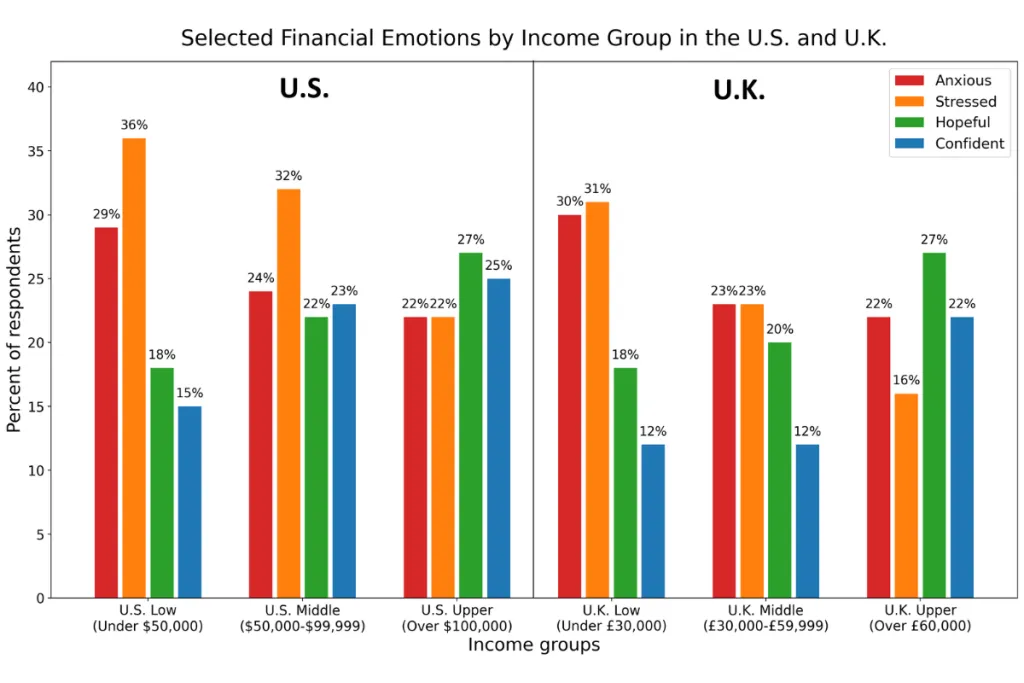
Note: More emotions exist than what is shown. Please see other articles in this series to learn more.
The trend between income and sentiment persisted when respondents selected the emotions that best described their sentiment. From amongst the most selected emotions (seen above) we can see that the selection of positive words increases with income while the selection of negative words decreases. Notably, regardless of income group, the U.S. sample was more likely to select a positive or negative emotion than their U.K. counterparts who were more likely to select a neutral emotion. Broken down further, we can see that U.S. Low earners were more likely to select a negative emotion than U.K. Low earners, and U.S. upper earners were more likely to select a positive emotion than U.K. upper earners.
Conclusion
In conclusion, we add two new takeaways to our analysis in this series examining the IntelliSurvey sentiment dataset:
First, the U.S. income groups were more distinct and identifiable than their U.K. counterparts. The lowest U.S. earners more consistently selected negative emotions and scores than the U.K.’s lowest earners, and the highest U.S. earners more consistently selected positive emotions and scores than the U.K’s highest earners. It seems apparent that the U.K. income groups are more heterogeneous and likely to select neutral answers.
Second, the unfortunate truth that we all expected. Being in lower-income groups, regardless of national context, is associated with stressful financial circumstances. While it has been said that money can’t buy you happiness, it seems apparent that it makes things significantly easier. The poorest in our communities are financially identifying with feelings of anxiety, concern, and stress, while the richest in our communities are feeling hopeful, happy, and confident. We also found that for every 1-point increase in the income group, we see a corresponding 0.36-point increase on the sentiment scale.
With the growing financial crisis, I expect that the financial negativity we are seeing will bring down the positivity of the general feeling data, and when that time comes, societal discontent from the lowest earners will result in social unrest and all of the reactions that come with it.