Why You Need to Update Your Race Question
Quotas are often seen as a mundane consideration and left to research agencies, who copy and paste them from past projects. However, for quota to perform properly – i.e., ensure the sample is representative – the question must be aligned to census.
A common pitfall we observe is in the US race question. We will use this as an example to illustrate why the quota question format matters.
Understanding the Difference: Old vs. New Race Question Formats
Historically, US race was collected as a single-select question. The US Census, however, moved away from this with its 2000 field. Despite this, numerous research projects are significantly lagging in refreshing their approach.
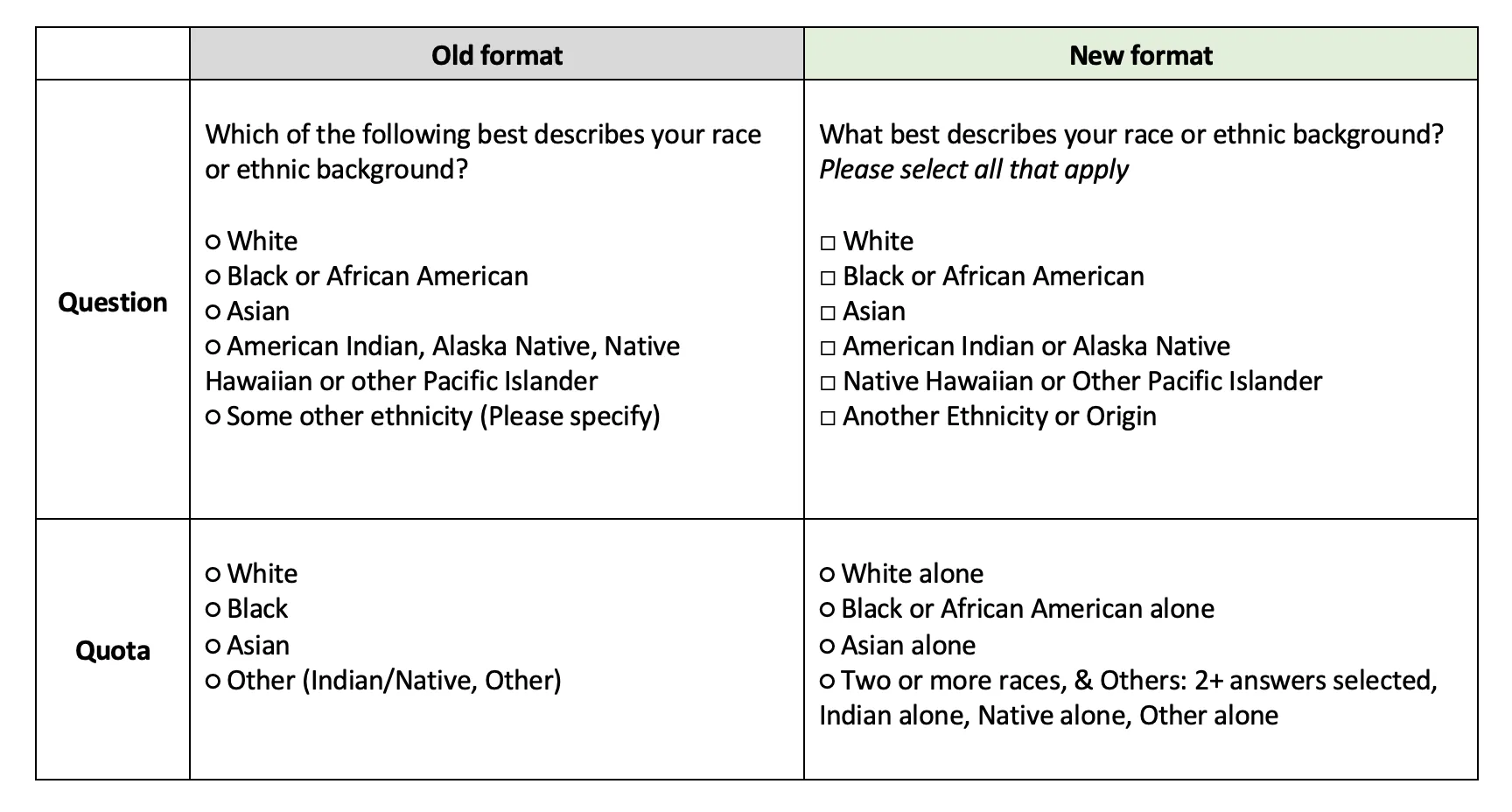
IntelliSurvey recommends switching all non-tracker projects now. Here is why…
Aligning to Census Matters
Demographic quotas play a key role in ensuring the sample is representative. They ensure the survey sample mirrors the mix of demographics in the target audience. Either the target demographics are known in advance, or they are inferred from a first representative stage in which we balance the starts (also called “clicks”) to the country’s general population statistics. Many sources publish statistics about a country’s population. The country census is nearly always the most accurate source because:
- It is conducted for public interest.
- It has by far the largest sample size and best balancing thanks to large investments in data collection (pre-tests, often at least partially face-to-face, etc.).
To compare apples to apples, the survey data should be collected in a format that is as close as possible to the census.
For example, if a country only publishes age statistics by decades in its census (e.g. 5% born after 2020, 12% born 2010-20, 14% 2000-10, etc.), we will want to ask the respondents for their birth year and follow the same buckets (rather than the traditional 18-24yo, 25-34, etc.).
The US Census Race Format: A Historical Shift
Until the 1990 wave, the US Census used to ask ethnicity as a single-answer question. But they changed it with the 2000 census in an effort to better capture diversity and the way people self-describe.
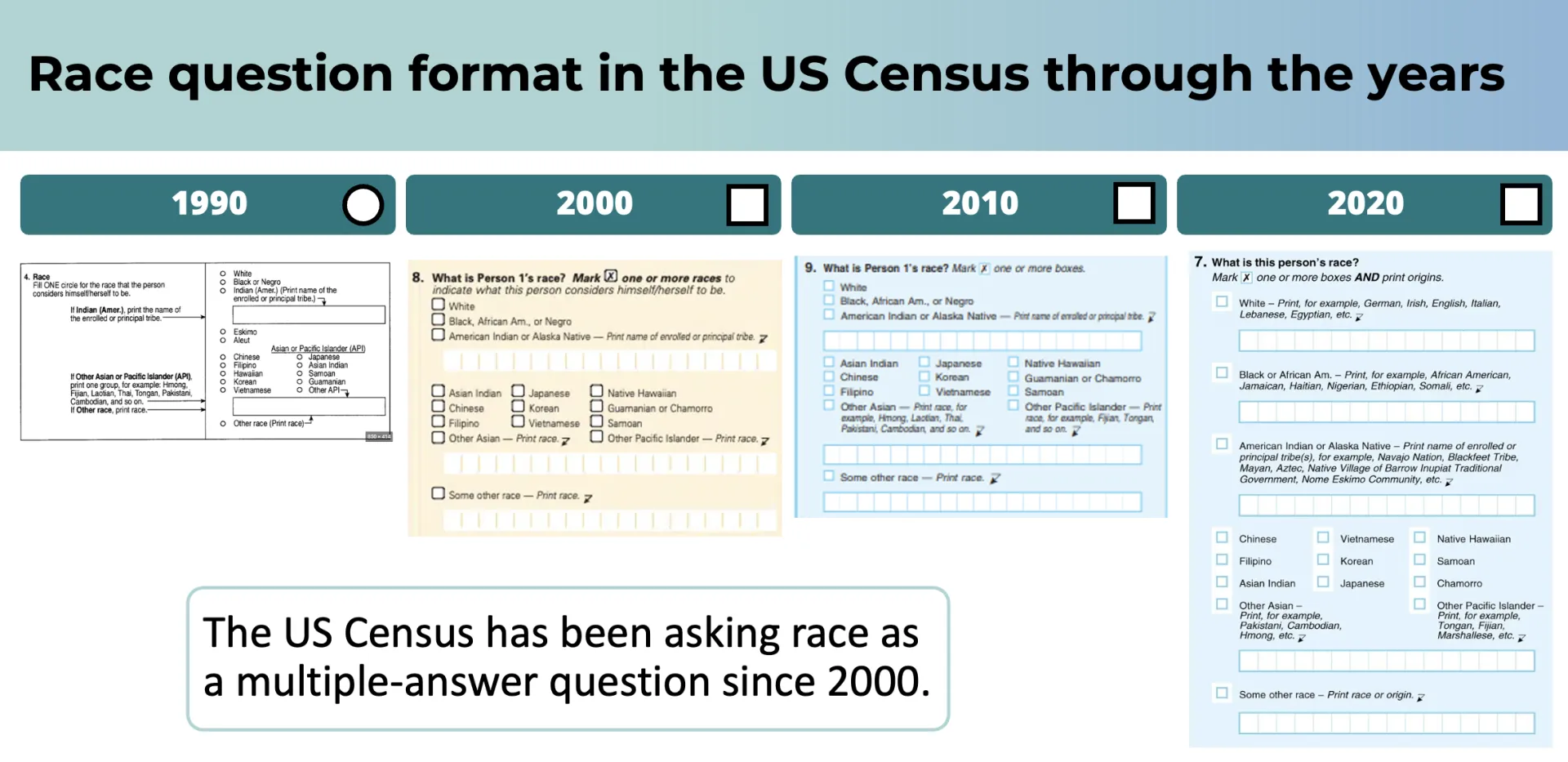
Since 2000, the US Census has also been reporting the data with a “Two or More Races” summary option. The standard reporting (as per US Census Quickfacts) is now along the following buckets:
- White alone
- Black or African American alone
- Asian alone
- American Indian and Alaskan Native alone
- Native Hawaiian and Other Pacific Islander alone
- Two or More Races
Recommended Format
The census collects race in much more detail, with 15 different options. So why not push the logic and replicate it in full? Demographics efficiency is important to avoid overly long screeners and attention loss. They are:
- Fast to read for the respondent.
- Coded live (recoding open-ends after the fact would impact changes of quotas and potentially going back to field)
We also collapse some of the details for the quotas. We recommend grouping “Two or More Races”, “American Indian or Alaska Native”, “Native Hawaiian or Other Pacific Islander” and “Some Other Race” together. The latter groups each account for less than 2% of the population. Given practical considerations of fielding with 5% (narrowest 2%) variance, quota groups need a minimum size of ~5%. We bucket these groups to achieve this critical mass.
A Note About Hispanic Ethnicity
Let’s also acknowledge that Hispanic ethnicity is the second part of capturing race. This one tends to be properly aligned with census data in projects, hence not going into detail here. It should be kept as a separate question, as per the census. It’s worth including both “Hispanic” and “Latino” wording for better identification. Note that we don’t recommend detailing Mexican vs Puerto Rican vs Cuban vs Other Hispanic. Respondents from these origins will identify as “Hispanic” or “Latino,” and as mentioned above, a single option limits confusion and increases efficiency.
Update Your Race Question Now
Stop compromising your research integrity with outdated survey practices. Take action by reviewing your current demographic questions, especially those related to race and ethnicity, and align them with the most current census standards. Your data, and the crucial decisions that stem from it, depend on this vital shift.
IntelliSurvey’s dedicated research team is available to facilitate a seamless and effective transition to modern best practices. Contact us to discuss your next project and how we can help protect the integrity and utility of your data.