Survey Translation Tips: Managing Repeated and Piped Text in Multi-Country Studies

In a market researcher’s ideal world, we’d write a project for one country and use an easy tool like Google Translate to make it relevant for other markets. However, there are always local nuances to consider, such as demographics, brands, currency, and more. Even the “simply translate” approach benefits from early planning in the original language. Different languages have unique grammatical structures that should be taken into account when designing the original questionnaire.
If you’re working on an international survey, here’s your crash course in handling these tricky translations like a pro.
Chaining Repeated Text
What is “Chained” Text?
Chaining refers to linking repeated pieces of text—whether a word, expression, or full sentence—so that it only needs to be translated once and then applied throughout the rest of the survey. This method offers clear advantages: it saves time by making translation more efficient and ensures consistency with the original language.
When to Use Chained Text
This approach works well for sentences that appear frequently, such as instructions like “Select all that apply.”
Here’s the Catch
When chaining text, it’s important to proceed with caution. English is relatively simple grammatically, while other languages often have more complex syntactical variations and grammar rules. The same term may require different translations when used in different contexts.
Example
Consider the translation of “None” as the “not applicable” option in the following two multiple-select questions:
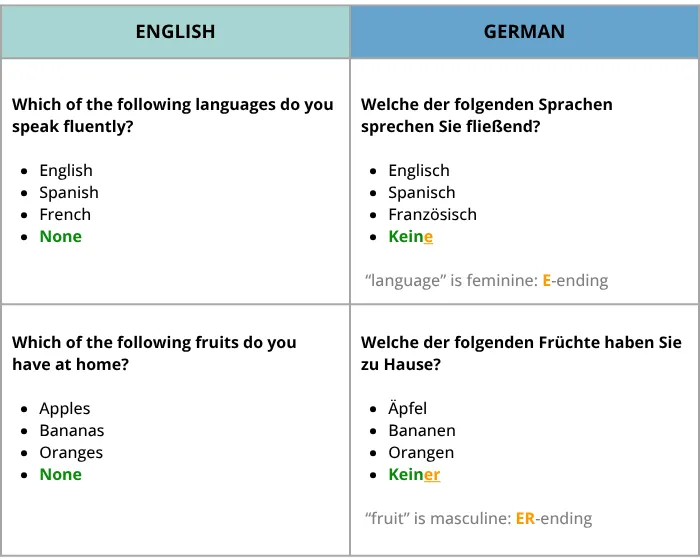
As shown above, “None” translates differently based on the gender of the object (e.g., “language” vs. “fruit”). If we chain or link the translation of “None” across the entire survey, we risk introducing errors that would appear unnatural to native speakers. This is when it’s beneficial to “unchain” the translation, ensuring that each instance of “None” is translated individually and correctly in context.
PRO TIP: The IntelliSurvey platform enables programmers to define chaining preferences at both the survey level and the question level. We recommend keeping the survey chained (the default setting) and unchaining specific questions for maximum efficiency. If you need help, our experienced survey programmers have vast experience with this procedure.
Tips for Piping Text
What is “Piped” Text?
Text piping is a powerful tool that lets you dynamically pull a respondent’s earlier answer into a later question. Whether with or without a routing selection process, piping creates a personalized, logical, and context-specific follow-up. For example, based on a respondent’s satisfaction with all the brands they use, you can ask what they like or dislike about each specific brand.
Why Piped Text Can Be Tricky in Translations
Piping text must be handled carefully when designing surveys in multiple languages. As mentioned earlier, languages such as German often involve complexities like noun agreement, verb conjugation, word order, etc. These variations can make piping tricky in certain situations:
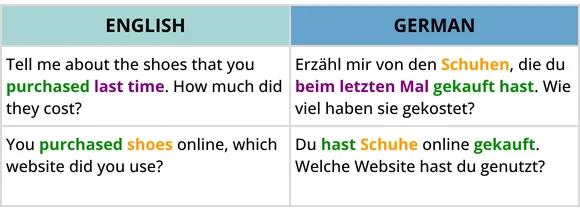
- The same word might translate differently in different sentences: agreement of nouns/adjectives (gender and quantity), conjugation of verbs, etc. (see below: “Schuhe” vs. “Schuhen”)
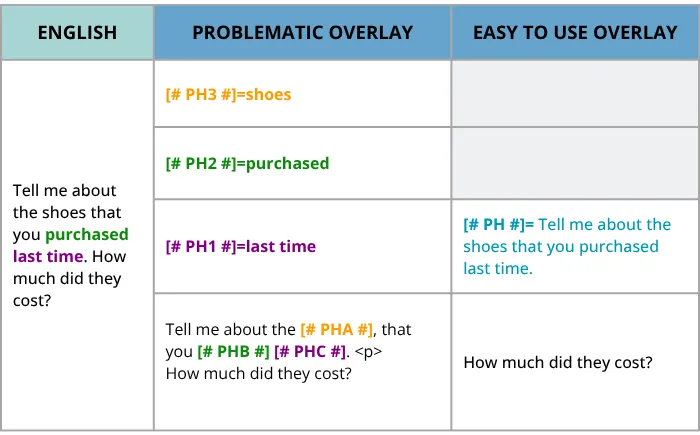
- Word order in the sentence may change, which can pose challenges for translators, particularly when Excel overlays are unclear about which part is piped (see below: “purchased” vs. “last time”)
- In some languages, words may be split differently in a sentence, creating additional complexity (see below: “hast … gekauft”)
Piped Text Translation Example
Let’s look at a couple examples to highlight these challenges. The colors highlight the same words for piping in both languages.
Things may get even more complicated if translators are unaware of what text is being piped. To avoid confusion, we recommend sharing an explicit word questionnaire whenever a situation like the following arises:
Top Tips for Piped Text
So, should you forgo piping altogether? Absolutely not— piping is too valuable a tool in survey design to forgo. However, it’s crucial to follow these three key rules to ensure smooth translations:
- For complex sentences, pipe the full sentence. As a complete unit, the text will be translated logically without issues.
- For short text (e.g., brand names, day of the week), pipe the smallest consistent grammatical unit and double-check in context to ensure it translates in a consistent manner
- Don’t pipe unnecessarily. For example, when building your questionnaire from a template that has a placeholder for the product category, replace the piping placeholders with hard-coded text specific to that project before moving to translations. This can simplify translation and reduce unnecessary complexity.
Bottom Line: Plan Early for Smarter Translations
Properly managing repeated and piped text is essential for creating smooth and efficient multilingual surveys. By carefully considering translation variations, leveraging text chaining and piping thoughtfully, and ensuring clarity for translators, you can avoid errors and deliver surveys that feel natural to respondents across different languages.
The IntelliSurvey platform offers a variety of features to support your translated projects, including AI tools, in-line editing, and filters to easily find questions with outstanding translations. If you prefer a done-for-you approach, our team of multi-lingual survey experts is available for managed translation services.
For more information on how our platform and services can benefit your next global survey, please get in touch.